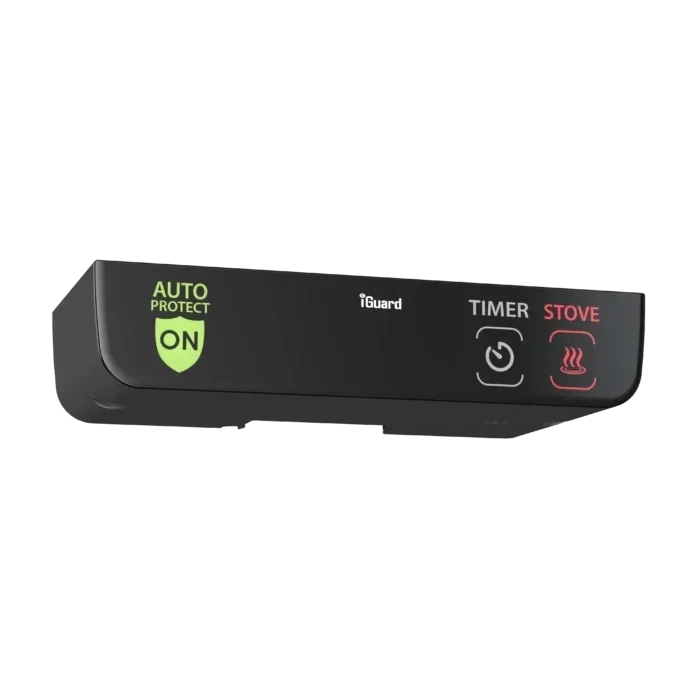
iGuard partnered with PDE from concept through manufacturing readiness across all eight disciplines the program required.
The Gen 2 design follows a single discipline. The device only ever surfaces what’s relevant to what the user is doing right now: no menus to navigate, no irrelevant buttons to ignore, no screen to study. The same intent runs through the industrial design, the sensor architecture, and the firmware behavior alike.
The industrial design and mechanical design team produced injection-molded parts qualified for production tooling: main enclosure, tinted faceplate, LED shroud, and graphic mask. The dead-front faceplate reads as a uniform opaque surface when the device is idle, disappearing into the kitchen. When the stove is in use, the backlit display surfaces only the controls relevant in the moment, directly through the surface, with a refined consumer-product appearance and no visible buttons or crevices.
The custom mmWave radar daughter board, developed by PDE, mounts behind the faceplate and detects occupancy through the enclosure material with no visible aperture. mmWave radar reads stillness as occupancy. Whether the cook is at the stove or sitting at the table waiting for water to boil, the system knows someone is there. The result is a safety device that stays in the background until it needs to act.
The firmware stack PDE developed for iGuard covers the full system: core state machine, sensor processing (radar, capacitive touch, temperature), wireless communication, display management, audio alerts, and IoT connectivity. Z-Wave protocol integration, including a partner integration guide for smart home certification testing, was developed for a planned post-launch release. The MQTT-based cloud integration enables remote monitoring, over-the-air updates, and the smart home and insurance platform connections that the Gen 2 architecture now supports.
The Gen 2 product made its debut at CES 2026, where iGuard earned a Best of CES 2026 Finalist designation in the Age Tech category and was selected as one of six companies for the CTA Foundation’s “Aging Independently” pitch competition on the Eureka Park Startup Stage.