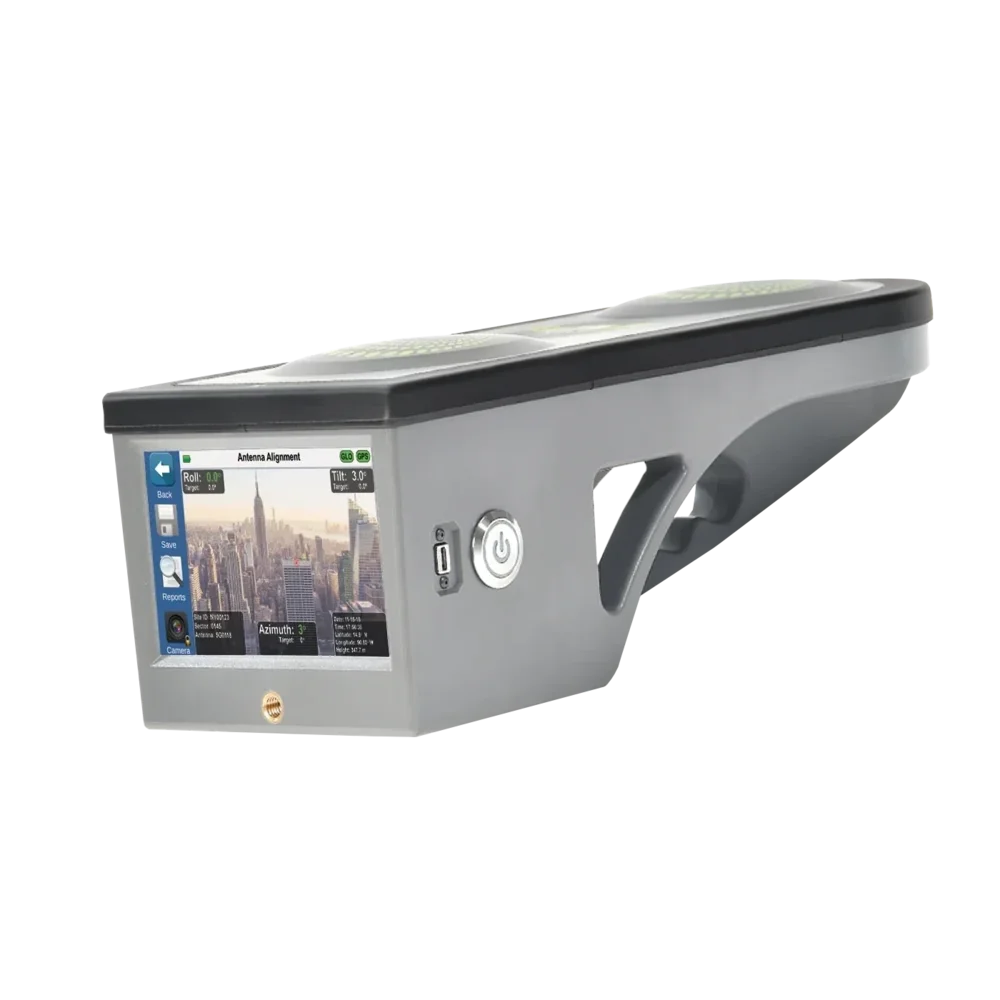
The 3Z RF Vision is a rugged handheld antenna alignment tool with an integrated camera and augmented reality overlay, designed to guide technicians through precise panel and microwave point-to-point antenna alignment directly on a live camera feed.
The 3Z RF Vision, now part of the Viavi Solutions portfolio, is a compact handheld tool for aligning cell tower antennas. It puts a live camera feed, an AR alignment overlay, and detailed reporting capabilities into a device small enough to use with one hand while standing on a mast.
3Z developed the hardware and brought PDE in to build the embedded Linux system running on the device, including the augmented reality interface. PDE also collaborated with 3Z’s hardware team during bring-up.
The Challenge
No Room for a Second Trip
Aligning a cell tower antenna is a job done at height. Getting up there takes time and effort, and every unnecessary interaction with the device costs more than it would at ground level. A slow workflow, a confusing menu, or a UI that requires too many steps to confirm a reading means the technician either spends longer on the mast than they need to, or they come back down and go back up.
The embedded system needed to support an AR interface that could display alignment guidance as an overlay on a live camera feed, giving technicians a clear, real-time visual reference without needing to interpret separate instruments. The whole thing had to run reliably on resource-constrained embedded hardware in a form factor small enough for one-hand operation.
The core requirements were:
Augmented reality overlay: real-time alignment guidance composited onto the live camera feed
Efficient UI: minimal steps to get to the information a technician needs on the mast
Embedded Linux platform: a stable, maintainable OS foundation on constrained hardware
Reporting: on-device capture and logging of alignment results
The Solution
Embedded Linux with an AR Interface
PDE built the embedded Linux system running on the RF Vision from the ground up. The OS configuration was tuned for the target hardware, keeping the platform stable and responsive within the memory and processing constraints of the device.
The augmented reality interface sits on top of the live camera feed and overlays alignment guidance in real time. A technician points the device at the antenna and the overlay tells them what they need to know without any mode switching or menu navigation. The UI was designed around the assumption that the person using it has one hand on the mast and is not interested in reading a screen more carefully than necessary.
PDE also worked alongside 3Z’s hardware team during bring-up, supporting a clean transition from prototype to production hardware.